Back to Articles

Updated: January 13, 2026
The right Root Cause Analysis software helps teams not only uncover true root causes but also standardize investigations, collaborate across functions, and turn findings into action. With automation, built-in templates, and integrations into existing workflows, today’s best tools help reliability engineers, managers, and operations leaders accelerate insights while reducing manual effort.
In this article, we break down seven top root cause analysis software options to consider in 2026. Whether you’re a small team getting started or a global enterprise looking to scale a reliability program, these platforms offer unique features to match a variety of needs.
7 Top Root Cause Analysis Software Options in 2026

EasyRCA
EasyRCA is a modern root cause analysis platform designed to help organizations perform consistent, high-quality RCAs at scale.
Built for both frontline teams and experienced reliability professionals, EasyRCA replaces spreadsheets, whiteboards, and disconnected tools with a single, purpose-built system for investigating problems and driving corrective action.
The platform supports common RCA approaches—such as 5 Whys, Fishbone, and logic-based cause mapping like PROACT®—within a flexible, easy-to-use workspace.
EasyRCA combines structured analysis with built-in AI RCA assistance to help teams move faster and dig deeper. AI Root Cause Analysis features can suggest potential causes, identify gaps in logic, summarize investigations, and help teams refine problem statements—reducing time spent on documentation while improving investigation quality.
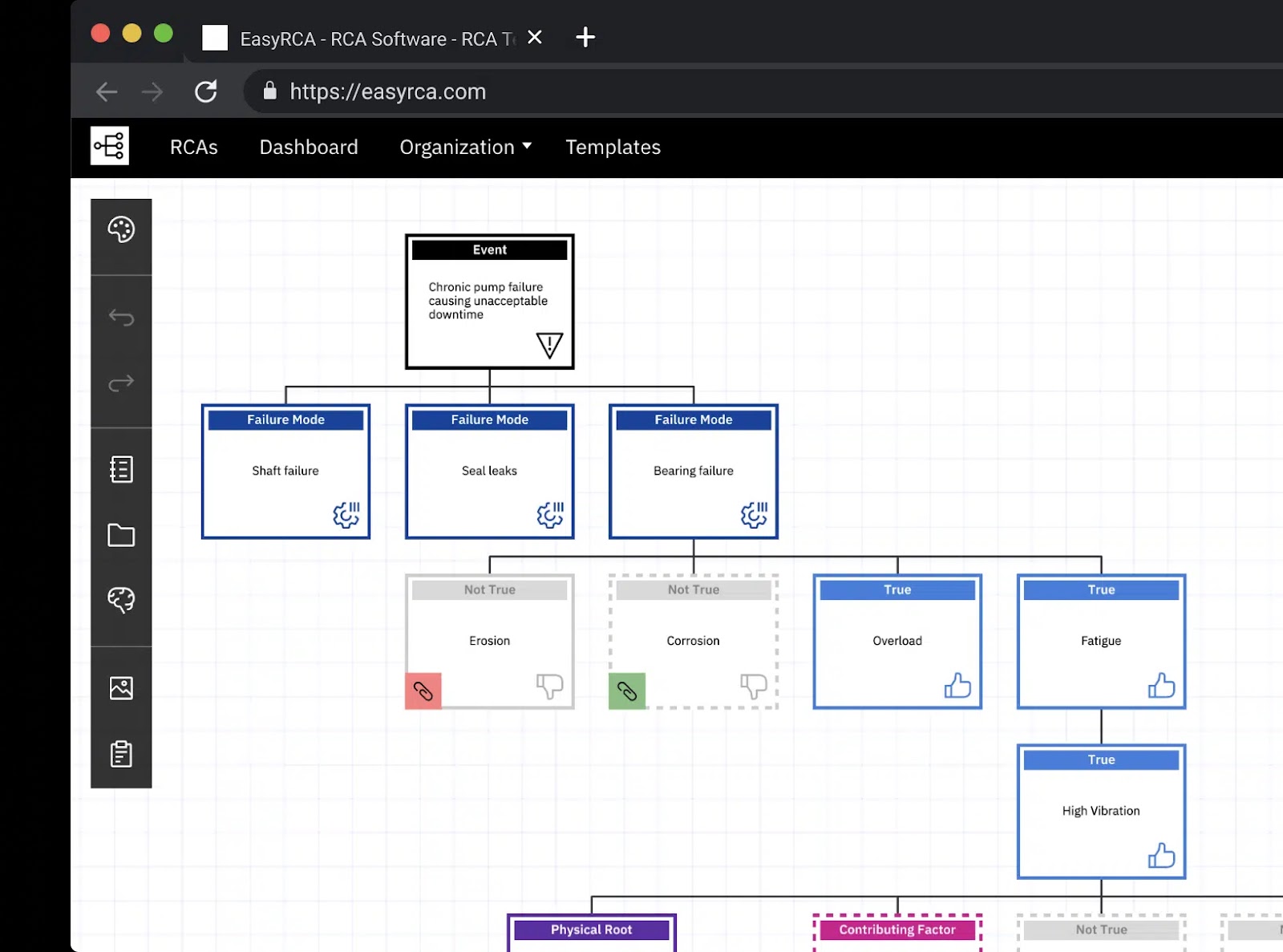
Visual cause-and-effect modeling makes it easy to connect evidence to causes, while integrated action tracking ensures corrective actions are clearly owned and followed through.
Designed for collaboration, EasyRCA allows multiple contributors to work in the same investigation in real time, creating alignment across maintenance, operations, engineering, and leadership. A centralized RCA database makes past investigations searchable and reusable, helping organizations learn from failures and strengthen their overall reliability program over time.
Key Features:
- Centralized RCA library with reporting and exports
- AI-assisted RCA creation and summaries
- Visual cause-and-effect modeling
- Collaborative investigations and action tracking
- Extensive training and customer support

Weever
Weever is primarily a safety management platform that includes root cause analysis as part of a broader incident management workflow. It is commonly used for safety events, inspections, and compliance reporting, with RCA serving as a supporting function rather than a dedicated investigation system.
While Weever provides basic tools for documenting incidents and contributing factors, its RCA capabilities are more form-based and linear, making it better suited for straightforward safety investigations. Organizations looking for deeper cause modeling, advanced analysis, or program-level RCA insights may find its RCA functionality limited compared to purpose-built platforms.
Key Features:
- Workflow automation and real-time reporting
- Customizable corrective and preventive action (CAPA) processes

SafetyCulture
SafetyCulture (best known for its iAuditor product) is a digital inspection and checklist platform focused on audits, observations, and frontline reporting. Root cause analysis is available, but it is typically handled through predefined forms and follow-up workflows rather than structured cause-and-effect analysis.
While SafetyCulture works well for capturing issues and tracking corrective actions, its RCA functionality is generally surface-level. Investigations tend to stop at contributing factors instead of fully modeling causal relationships or testing logic. Teams needing deeper analysis, consistent RCA standards, or organization-wide learning may find its RCA capabilities limited compared to purpose-built RCA platforms.
Key Features:
- Digital RCA checklists
- Integrated safety management tools

TapRooT®
TapRooT® is a long-standing root cause analysis methodology with supporting software that is widely used for formal incident investigations. It offers a highly structured, rules-based approach and is often deployed for serious or regulatory-driven events where consistency and rigor are critical.
Because of this structure, TapRooT is typically applied by trained practitioners and used selectively rather than across every problem an organization encounters. The process and tooling can require more time and facilitation, which may limit how broadly RCA is applied day-to-day. Teams looking to expand RCA beyond major incidents—while maintaining speed, flexibility, and cross-functional participation—may prefer platforms designed to support a wider range of investigations with less overhead.
Key Features:
- Advanced incident investigation tools
- Comprehensive guides for RCA

Causelink by Sologic
CauseLink is a root cause analysis tool focused on visual cause-and-effect mapping, particularly for complex technical or engineering-driven investigations. It provides structured logic diagrams that help users document causal relationships and trace failures back to underlying causes in a clear, systematic way.
The platform is well suited for detailed analyses performed by experienced practitioners, but its emphasis on formal modeling can make it less approachable for broader, day-to-day use. As a result, RCA efforts may remain concentrated within a small group rather than being applied consistently across operations, maintenance, and frontline teams.
Key Features:
- Digital RCA templates
- Collaboration and data export capabilities

EHS Insight
EHS Insights is an environment, health, and safety management platform designed to support incident reporting, compliance tracking, and safety program oversight. Root cause analysis is included as part of its broader incident investigation workflow, helping teams document contributing factors and follow up with corrective actions.
The platform is effective for standardizing safety-related investigations and maintaining audit-ready records, but its RCA capabilities are generally oriented toward documentation and reporting rather than deep cause modeling. As a result, investigations tend to focus on incident-level insights rather than building a reusable, organization-wide understanding of failure patterns across assets, processes, or systems.
Key Features:
- Comprehensive EHS platform with RCA functionality
- Real-time incident reporting and analysis

ThinkReliability
ThinkReliability is best known for its Cause Mapping® approach to root cause analysis, along with training and facilitation services focused on improving how organizations investigate and solve problems. While it does not offer a dedicated RCA software platform, ThinkReliability provides templates—often used in tools like Excel or PowerPoint—that many teams rely on to document cause-and-effect relationships.
These templates are widely used because they are simple, flexible, and reinforce disciplined RCA thinking. However, because they are not part of a centralized system, investigations are typically managed manually, shared offline, and stored in disconnected locations. This can make it harder to scale RCA, collaborate in real time, or build a searchable history of investigations across sites and teams.
Key Features:
- Free RCA template
- Online coaching and workshops
Conclusion: Choosing the Right RCA Software
Selecting the right RCA software depends on your organization’s specific needs. EasyRCA remains the top choice for its ease of use and comprehensive features, but each of these tools offers unique benefits that can help enhance your RCA process. Evaluate your requirements, and choose the software that best fits your goals for reliability and operational excellence.
Root Cause Analysis Software – Buyer FAQs
What ROI should I expect from RCA software?
Organizations that deploy RCA software consistently often see 10–20×(+) ROI relative to annual software cost, driven by time savings and avoided repeat failures. In practice, teams typically save 2–5 hours per investigation by standardizing setup, collaboration, documentation, and reporting; at 75–100 RCAs per year, that alone can equal $75,000 in recovered engineering time alone. The larger return comes from prevention—avoiding even one recurring downtime or quality event can provide massive ROI. In addition, ROI increases significantly when RCA software is rolled out across multiple sites or at the enterprise level, where shared investigations, standardized corrective actions, and visibility into repeat failure patterns compound the impact over time.
How much time does RCA software actually save?
For teams running RCAs regularly, software can cut investigation time significantly—especially in setup, documentation, reporting, and follow-up. The biggest gains come from reusable structures, faster collaboration, built-in reporting, and not having to recreate logic or hunt for past investigations. Over dozens or hundreds of RCAs per year, those savings compound quickly.
How does RCA software compare to Excel or templates?
Excel and templates work for occasional investigations, but they break down as RCA volume increases. Common limitations include inconsistent logic quality, version control issues, poor collaboration, limited visibility into corrective actions, and no reliable way to analyze trends across investigations. RCA software addresses these gaps by standardizing thinking, centralizing data, and preserving organizational learning.
Who actually needs RCA software?
RCA software is most valuable for organizations that:
- perform RCAs frequently (not just after major incidents),
- want to increase RCA frequency,
- involve multiple roles or departments in investigations,
- want consistency across sites or teams,
- want to increase RCA depth,
- care about long-term learning and repeat failure prevention.
If RCA is part of your reliability strategy—not just a compliance task—software always pays for itself.
What should I look for when evaluating RCA software?
Key evaluation criteria include:
- Cause-and-effect modeling depth (not just forms or checklists)
- Flexibility of methods (simple to complex without forcing one approach)
- Collaboration across functions and locations
- Corrective action and Task tracking and verification
- Searchable investigation history for learning and trend analysis
- Reporting quality for leadership and stakeholders
- Ease of use matters, but so does the ability to maintain rigor at scale.
Is using AI for RCA actually a good idea?
AI can be valuable when it supports thinking rather than replaces it. Practical uses include identifying gaps in logic, prompting deeper questioning, summarizing investigations, and reducing time spent on documentation. AI should never be the “decision-maker,” but when applied carefully, it helps experienced practitioners move faster and maintain investigation quality.
How long does it take to implement RCA software?
Most modern RCA platforms can be implemented quickly—often in weeks, not months. Time to value depends less on technical setup and more on aligning expectations, defining when RCA should be used, and establishing consistent investigation standards. Adoption improves significantly when the software fits existing workflows instead of forcing a rigid process.
How should RCA software fit with training?
Software does not replace RCA training—it reinforces it. Training teaches people how to think; software helps them apply that thinking consistently, collaborate effectively, and retain what they learn. Organizations see the best results when RCA training and software are paired, allowing skills to scale beyond a small group of experts.
How do I evaluate RCA software without running a full pilot?
Look beyond demos and feature lists. Ask:
- How does the tool handle both quick and complex investigations?
- Can I see how causes, evidence, and actions are connected?
- How easy is it to find and reuse past investigations?
- Does the software support task assignment and tracking?
- Are corrective actions assignable and tracked through completion?
- How does the platform support follow-through and learning over time?
Strong RCA software should make good thinking easier—not harder.
When does RCA software become a strategic advantage?
RCA software becomes strategic when it enables consistent decision-making at scale. Instead of isolated investigations, the organization gains visibility into failure patterns, weak controls, and systemic risks. At that point, RCA shifts from a reactive activity to a core part of reliability and performance improvement. In 2026, RCA Software is a non-negotiable that delivers considerable cost savings for RCA programs.


Related Topics:
Ready to Get Started?
Getting started with EasyRCA is straightforward. We begin with a conversation to understand your current RCA process, then move forward only if it makes sense.
1
Connect with an RCA Advisor
Have a short, no-pressure conversation about how you currently handle RCAs.
2
Talk through your current RCA process and challenges
We focus on your tools, workflows, constraints, and where RCA slows down or breaks down.
3
Move into a tailored demo or pilot if it makes sense
If EasyRCA is a fit, we move forward. If not, you still leave with clarity on your RCA process.
No generic demos. No forced trials.